
How large E-Ink monitors transform productivity
The core appeal of e-ink for extended work sessions
Anyone who spends long stretches of time in front of conventional screens knows the unmistakable feeling that arrives after hours: a sort of tired pressure behind the eyes, sometimes accompanied by a dull headache or a fading ability to focus. Traditional LCD and OLED displays constantly emit light directly toward the viewer, and although brightness and blue-light filters offer partial relief, the sensation still builds over the day. E-ink technology approaches visual display from a different angle.
Instead of projecting light outward, an e-ink screen reflects ambient light much like a page in a book, creating a surface that feels visually calm and stable. The display remains static until the content changes, so the absence of light flicker contributes to a sense of stillness. People often describe the experience as reading printed text without the weight of holding a stack of pages.
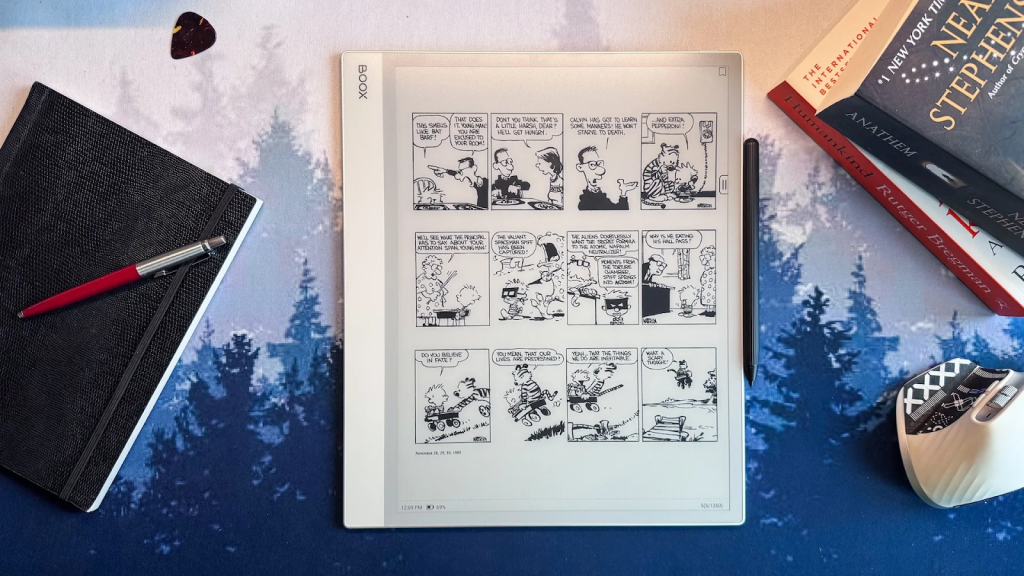
Boox Note Max Open Box encourages deeper engagement. When the screen does not fight for attention with brightness, contrast, and animated elements, the mind settles into a more concentrated rhythm.
Why screen size matters for productivity on e-ink
While compact e-ink readers have been popular for years, their core limitation is obvious once someone tries to use them for anything more complex than reading a novel. A full page of a technical manual or a research article shrinks awkwardly on a small screen. Constant zooming interrupts flow, and multitasking is nearly impossible.
A large e-ink monitor, especially around the 13.3-inch range, shifts the experience entirely. The bigger surface allows full-page PDF viewing, two-column layouts, or split-screen work that feels genuinely productive. You can have a document open on one side and handwritten notes or an outline on the other, switching between tools without losing your train of thought.
The feeling is less like using a tablet and more like sitting in front of a full sheet of digital paper. That scale allows room to think spatially: diagrams can spread, mind-maps can branch, and complex documents retain their natural structure. Designers sketch without shrinking their page to postage-stamp size, musicians write scores without scrolling every few seconds, and students mark up textbooks with clarity and precision.
The writing experience: from paper to digital notes
One of the most striking aspects of large e-ink tablets is the way writing on them feels. The textured surface, combined with a pressure-sensitive stylus, produces a faint resistance that imitates the drag of pen on paper. It slows the hand just enough to encourage clarity and care.
Handwritten notes on glass tablets often feel slippery and clinical, but here the motion has intention. Sketching shapes, outlining a theory, or annotating diagrams becomes intuitive, and the brain responds as it does with analog tools. The difference is what happens afterward: handwritten pages can be organized infinitely, copied, exported, searched, or shared. The mess disappears without losing personality.
For people who think through handwriting—teachers, researchers, architects, musicians, or anyone who uses doodles and margin notes to ignite ideas—the combination of tactile familiarity and digital structure is powerful.
Integrating a secondary e-ink display into your workflow
Few people replace their main color monitor with an e-ink device; instead, the real strength emerges when it becomes a specialized second screen. When connected to a laptop or desktop, a large e-ink panel can hold a reference document, long-form manuscript, code documentation, or a clean, distraction-free writing window.
This arrangement divides tasks into two mental zones.
- The primary display carries fast-moving, visually heavy work—image editing, spreadsheets, design, messaging, video.
- The e-ink display remains quiet and stable, reserved for focus-intensive reading and composition.
Writers often describe the setup as stepping into a library each time they move their eyes to the e-ink monitor. Programmers use it for terminals and logs. Lawyers and researchers keep complex case files front and center. The workspace becomes organized not just by screens but by emotional state: concentrated thought versus fast response.
Communities sharing techniques for workflows like these, including those around Einktab, offer insights into pairing devices, setting up custom writing environments, or discovering unexpected uses such as sheet music display or project planning boards. The conversation continues to evolve as more people experiment beyond reading.
A quiet transformation
Large e-ink monitors change productivity not by adding bright colors, animations, or noise, but by removing them. They create space—mental and physical—for focus. They invite clarity over urgency, flow over speed, craft over quick reaction.
In a world of constant notifications and multitasking pressure, a surface that feels like calm paper may be more revolutionary than any glowing, high-resolution display. The transformation happens slowly and quietly: work feels lighter, attention steadier, ideas less fragmented.